What does solopreneur mean?
You've probably heard the word everywhere lately. On LinkedIn, in podcasts, in job descriptions from people who very clearly don't have a job anymore. But what does solopreneur actually mean - and more importantly, is it what you're becoming?
Let's get into it.
The actual definition
Merriam-Webster defines a solopreneur as "one who organizes, manages, and assumes the risks of a business or enterprise without the help of a partner." Clean. Simple. Slightly terrifying if you've never done it before.
The word itself is a mashup of "solo" and "entrepreneur." You run the show. The whole show. Sales, delivery, marketing, client management and yes - the occasional existential crisis at 11pm about whether your pricing is right.
But here's what the dictionary doesn't tell you: solopreneurship, done properly, isn't a lonely grind. It's a design choice. A deliberate way of building a business and a life on your own terms - where your expertise is the product, your reputation is the engine and your calendar only has names on it you actually want to work with.
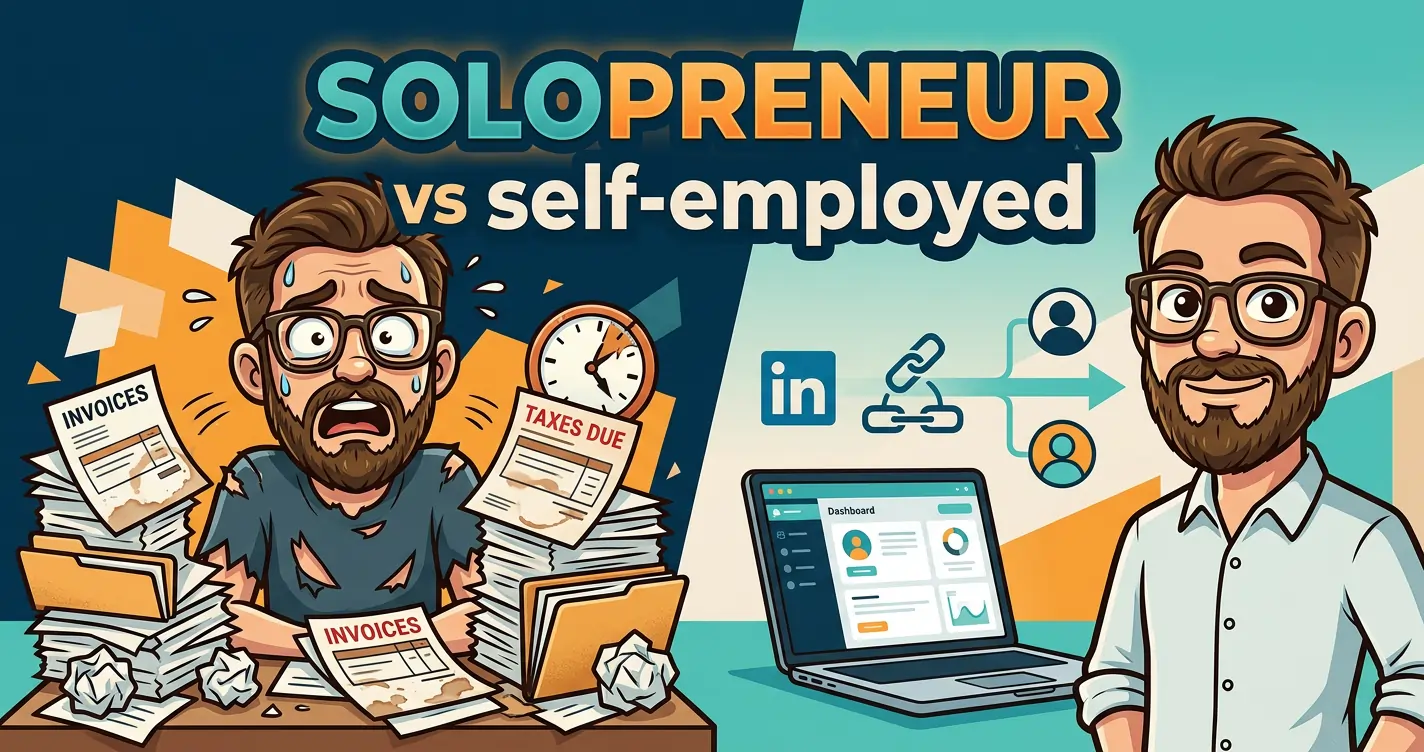
Solopreneur vs freelancer vs entrepreneur - what's the difference?
People use these words interchangeably. They're not the same thing.
Freelancer - you sell your skills by the hour or by the project. You get paid when you work. Stop working, stop earning. Your clients own your time.
Entrepreneur - you build a business with the intention of scaling it, usually by hiring a team, seeking investment or eventually exiting. The goal is to build something that runs without you.
Solopreneur - you run a business alone, built around your expertise, with the intention of creating consistent premium income without trading every hour for a pound. You don't want a team. You don't want a pitch deck. You want freedom, great clients and work that actually pays what you're worth.
The biggest difference between a solopreneur and a freelancer isn't the work - it's the mindset. A freelancer adapts to client requirements. A solopreneur builds a position, sets the terms and attracts clients who fit.
And the difference between a solopreneur and an entrepreneur? The solopreneur isn't trying to exit. They're trying to live.
Why solopreneurship is having a moment
This isn't a trend. It's a structural shift.
There are now nearly 30 million solopreneurs in the US alone. In the UK, over 4.2 million people are solo self-employed, contributing £331 billion annually to the economy. The number of independent professionals globally is projected to hit 86.5 million by 2027.
And the financial case is real. After five years, solopreneurs out-earn their employed peers by 25% on average. One in five solopreneurs earns between $100k and $300k annually - without hiring a single person. More than 75% reach profitability in their first year.
Clients are shifting too. 68% now report higher satisfaction and better ROI from independent consultants than from large agencies. People want to work with the expert directly - not get passed to a junior account manager three weeks after signing a contract.
The solopreneur era isn't coming. It's here.
But here's what most people get wrong about it
Being a solopreneur doesn't mean going it alone and figuring everything out through trial, error and a growing collection of half-finished Notion templates.
It means taking full ownership. Of your decisions, your direction and your results.
The market is the only judge. And she does not care about your feelings.
Most people who try solopreneurship without a clear system end up building themselves a very expensive job. They're busy. They're stressed. They're working with clients they'd rather avoid. They've left employment to do the same thing, just without the pension.
That's not solopreneurship. That's just self-employment with better branding.
Real solopreneurship - the kind that gives you $15k months, a 24-hour work week and a client list you're genuinely proud of - requires three things to be locked in before anything else:
-
A bulletproof niche - one specific person, one specific problem, zero confusion about who you're for
-
A premium offer - not a list of services but a clear outcome your ideal client is already trying to buy
-
A system for leads and sales - so clients don't feel like luck
Without those three things, you're not running a solopreneur business. You're running a hustle.
What kind of person becomes a great solopreneur?
Not everyone. And that's fine.
The solopreneurs who thrive tend to share a few things. They have deep expertise - usually seven or more years in one clear craft. They know their field well enough that they don't need to guess. They just need to package what they already know into something people will pay for.
They're also done with the corporate ladder. Or the agency politics. Or working for clients who don't value what they bring. They've spent years making other people's vision work. Now they want to build their own.
If that sounds like you, the transition isn't as complicated as it looks. It's just unfamiliar.
The solopreneurial mindset, in plain terms: no-one is coming to save you. The best strategy is doing all you can with what you have right now. New and exciting ideas are often just your way of avoiding the work. Repetition is the last law of learning.
That's not harsh. That's liberating. Because once you internalise it, you stop waiting for permission and start building.
The solopreneur lifestyle - what it actually looks like
Let's be honest about what the goal is here.
It's not hustle. It's not working from a laptop on a beach while pretending to drink a smoothie. It's something more real than that.
It's waking up on a Monday without dread. Working four days a week. Having a calendar full of clients whose problems genuinely interest you. Earning more than you did in your last job, with more control over your time than you've ever had.
That's what solopreneurship, built properly, looks like in practice. And in 2026, with the tools available - LinkedIn, automation, AI - it's more achievable than it has ever been.
Chris Corridore, a B2B brand designer, put it well after going through the process: "I feel so much more confident. I'm excited about creating content for the first time ever. I don't feel resistance towards that anymore. There's a structure to everything. It doesn't feel like guesswork anymore. I'm excited to start rising."
That shift - from confusion to clarity to momentum - is exactly what becoming a proper solopreneur feels like.
Where Moe comes in
Moe Choice spent years building businesses - twelve of them. Two exits. He's seen what works, what doesn't and what makes experienced professionals burn out trying to make the leap on their own.
His conclusion: the skills aren't the problem. The system is.
Most people who come to him are consultants, coaches, designers, writers and operators with years of proven expertise who are earning nowhere near what their knowledge is worth. Not because they're not good enough. Because they haven't built the right offer, positioned themselves clearly or set up a pipeline that brings in the right clients consistently.
That's what he helps them fix. One niche. One offer. One outcome. A system that runs on two hours a day of LinkedIn outreach - no ads, no funnels and no 250k followers required.
Adina Samuels called it "a strategy that made me more than $20k in just four weeks of implementation."
Mel Fox Dhar filled her group programme in four weeks and collected $12,000.
Stephane Seguin said: "He helped me get clarity on my niche in a way two other specialists couldn't in six months."
And Anu Timmerbacka: "Within two months, I've already closed two deals - which is basically making my investment back already."
These aren't unicorns. They're people with real skills who finally had the right system in place.
Ready to see the framework?
If you've read this far, you're probably at least considering the leap - or already mid-leap and wondering why it's harder than it looked.
The Free Masterclass breaks down exactly how service-based solopreneurs with real expertise build a $15k/month business on LinkedIn, without ads, funnels or starting from zero.
Live, interactive and completely free.
Frequently asked questions:
Do I need to quit my job first? No - most people start building their solopreneur system while still employed then make the leap when the income is there.
Is this only for coaches? No - it works for any service-based solopreneur with a proven craft: consultants, designers, marketers, writers, operators and beyond.
What if I've tried this before and it didn't work? The system matters more than the effort. Most people who've tried and struggled were missing either the niche clarity, the offer or the outreach process - the masterclass covers all three.

- Peace ✌️


0 Comments