Freelancer vs solopreneur: are you working for yourself or just working?
You left employment to work for yourself.
So why does your calendar still belong to everyone else?
Client deadlines. Last-minute requests. Another proposal. Another “quick thing” that somehow takes the whole afternoon.
You’re technically independent.
But your Monday morning looks suspiciously like your old job. Just with more invoices and nobody contributing to your pension.
That’s the question worth asking.
Not what you call yourself.
What you’ve actually built.
Freelancers build walls. Solopreneurs build castles.
A freelancer’s first question is:
“What do you need done?”
The question I want you asking is:
“Where are you trying to go and why does it matter?”
One starts with the task.
The other starts with the outcome.
I unpacked this on the Team of One podcast and the analogy that kept coming up was bricklayers versus castle-builders.
A bricklayer can be highly skilled. They work hard. They get paid for each wall.
But when they stop laying bricks, the work stops.
A castle-builder thinks about the whole structure. What it’s for. How the pieces fit. What needs to happen so it keeps standing.
Neither is a judgement on the quality of the work.
It’s a question about the model.
Too many experienced professionals want a castle but keep selling individual bricks.
Changing your title won’t change your business
Let’s get something straight.
Calling yourself a solopreneur doesn’t automatically make you better paid than a freelancer.
You can freelance with a clear niche, excellent pricing and a reliable pipeline.
You can call yourself a solopreneur and spend every evening chasing £300 projects.
The label isn’t the upgrade.
The upgrade is in how you position your expertise, price the work and find clients.
That’s the shift I’m talking about.
Moving from “I’m available to do things” to “Here’s the specific result I help this specific person achieve.”
Are you selling your effort or their outcome?
If you’ve spent seven or more years getting good at a craft, you probably have plenty to talk about.
Your methodology.
Your experience.
The tools you use.
The steps in your process.
All relevant.
But your buyer starts somewhere else.
“What changes for me?”
A founder doesn’t buy an operations consultant because they’re desperate to own another process document.
They want the business to stop falling apart whenever they take a day off.
A professional doesn’t hire a career coach because they’ve always wanted six beautifully structured Zoom sessions.
They want a better job.
The process supports the result.
It shouldn’t replace it in your offer.
The magic pill test
Imagine I gave you a pill that got you to $15k a month.
Instantly.
No extra work.
What would that be worth to you?
You probably wouldn’t say twenty quid.
Now, before anyone starts asking where the pills are, this is an exercise.
It gets you thinking about the value of the destination rather than the effort of the journey.
Your client does a version of that calculation too.
They weigh the result they want against the price, the risk and how much they trust you to deliver.
That doesn’t mean you can charge whatever you fancy.
It means your hourly rate isn’t the only useful place to start.
You need to understand what the outcome matters to them.
Then build an offer you can credibly deliver.
A position gives the right people a reason to choose you
“I’m a consultant available for projects” tells people you exist.
It doesn’t tell them why you matter.
A clearer position explains:
-
The specific person you help
-
The problem you work on
-
The outcome they’re trying to achieve
-
Why your experience makes you relevant
That clarity changes the conversation.
You’re no longer asking someone to work out how your entire career might be useful to them.
You’re showing them where it fits.
Christian Mather had talent and credibility but was spreading himself across too many directions. After we focused on one niche, one audience and one system, he booked three meetings a week, signed four dream clients and brought in £18,000 in upfront fees over ten weeks.
His title didn’t create that result.
The focus mattered.
Three things to do this week
1. Look at your last five clients
How did they find you?
Why did they choose you?
Were they buying a specific outcome or simply looking for someone available to do the work?
There’s nothing wrong with winning a client through outreach. I teach it.
The useful question is whether your message gives people a clear reason to choose you once you reach them.
If every conversation starts from scratch, look at your positioning.
2. Write your offer in one sentence
Try this:
I help [specific person] achieve [specific outcome] through [your approach].
Not “I help people with marketing.”
Not a paragraph containing every service you’ve delivered since 2009.
One person.
One outcome.
One clear sentence.
If you offer a guarantee, make sure you can honour it and explain its conditions. A confident offer isn’t permission to promise something outside your control.
3. Calculate what your business actually pays you
Take last month’s revenue and divide it by every hour you spent working.
Include delivery, prospecting, admin, proposals and the calls that didn’t turn into clients.
That gives you a rough revenue-per-hour figure before expenses and tax.
Not the flattering number you get by counting billable hours only.
If it makes you wince, investigate the model.
Your scope might be too loose. Your pricing might be too low. You might be spending too long winning each project.
Working harder won’t automatically fix any of those.
Build something that serves you
You don’t have to stop doing the craft you love.
You need to connect it to a business that makes sense.
A clear position.
An offer built around a result people value.
A repeatable way to find suitable clients.
A delivery process that doesn’t require you to reinvent everything every time someone pays.
That’s how you move from being available to being chosen.
And from filling your calendar to building a business you actually want to own.
Want to see how the pieces fit?
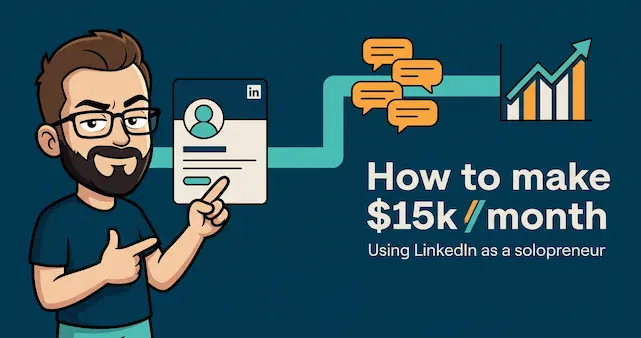
My free masterclass shows you the framework I teach service-based solopreneurs for building towards $15k months using LinkedIn.
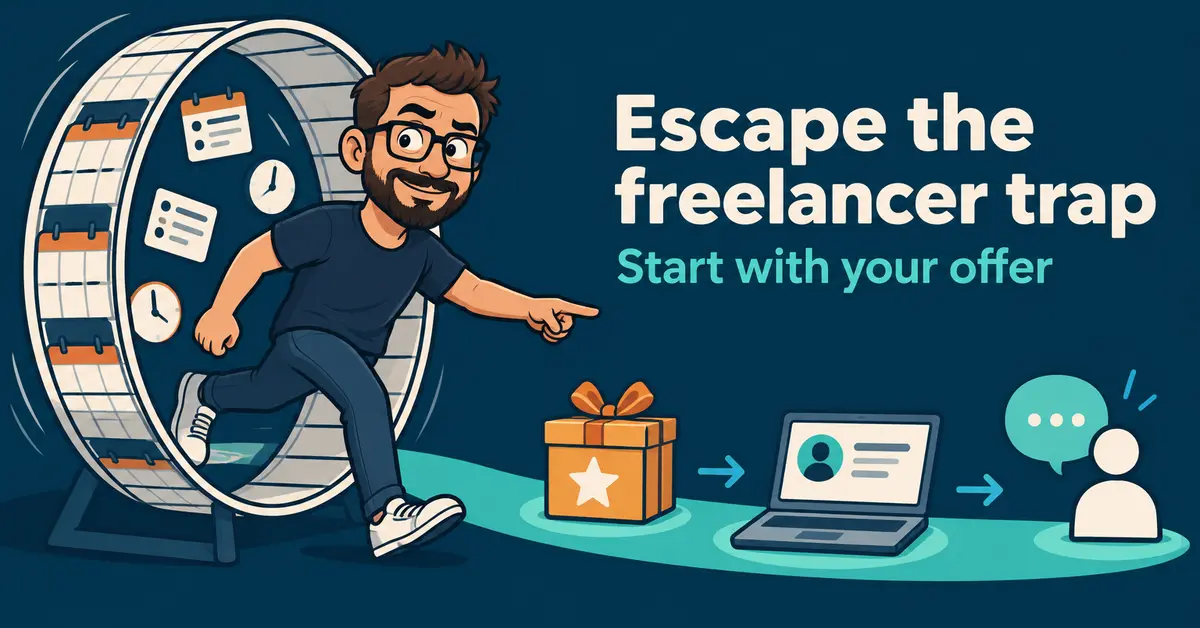
We cover the freelancer trap, niche selection, your dream offer and the conversations that connect your expertise to paying clients.
If you’re experienced at the work but tired of feeling like you’ve given yourself another job, start here.
P.S. “Founder” in your headline doesn’t make your calendar yours. Build the model first.

✌️
Moe



0 Comments